New DP-800 Exam Question | Valid Dumps DP-800 Free
Wiki Article
Every working person knows that DP-800 is a dominant figure in the field and also helpful for their career. If DP-800 reliable exam bootcamp helps you pass exams and get a qualification certificate you will obtain a better career even a better life. Our study DP-800 Guide materials cover most of latest real DP-800 test questions and answers. If you are certainly determined to make something different in the field, a useful certification will be a stepping-stone for your career, so why not try our product?
Microsoft DP-800 Exam Syllabus Topics:
| Topic | Details |
|---|---|
| Topic 1 |
|
| Topic 2 |
|
| Topic 3 |
|
>> New DP-800 Exam Question <<
100% Pass Quiz 2026 Trustable DP-800: New Developing AI-Enabled Database Solutions Exam Question
It is a common sense that in terms of a kind of Developing AI-Enabled Database Solutions test torrent, the pass rate would be the best advertisement, since only the pass rate can be the most powerful evidence to show whether the DP-800 guide torrent is effective and useful or not. We are so proud to tell you that according to the statistics from the feedback of all of our customers, the pass rate among our customers who prepared for the exam under the guidance of our Developing AI-Enabled Database Solutions test torrent has reached as high as 98%to 100%, which definitely marks the highest pass rate in the field. Therefore, the DP-800 Guide Torrent compiled by our company is definitely will be the most sensible choice for you.
Microsoft Developing AI-Enabled Database Solutions Sample Questions (Q79-Q84):
NEW QUESTION # 79
You have an Azure SQL table that contains the following data.
You need to retrieve data to be used as context for a large language model (LLM). The solution must minimize token usage.
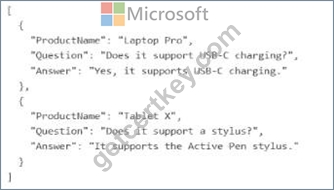
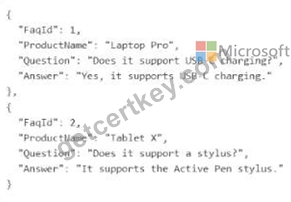
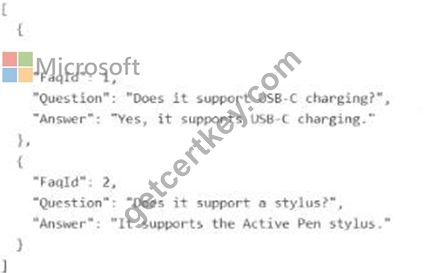
Which formal should you use to send the data to the LLM?
- A.

- B.
- C.
- D.
Answer: B
Explanation:
The correct choice is Option A because it provides the relevant semantic context the LLM needs while avoiding an unnecessary field that would add tokens without improving answer quality.
For LLM grounding and RAG-style context, Microsoft guidance emphasizes mapping and sending the fields that contain text pertinent to the use case . In this FAQ scenario, the useful context is the ProductName , the Question , and the Answer . Those three fields help the model understand both the subject domain and the actual Q & A pair. By contrast, FaqId is just a technical identifier and generally adds no semantic value for response generation, so including it wastes tokens.
That is why Option A is better than the others:
* Option A keeps the meaningful text fields and removes the low-value identifier.
* Option B is too minimal because it includes only the answer text as Prompt, which strips away the product and question context the LLM may need for accurate grounding.
* Option C keeps FaqId but omits ProductName, which can be important disambiguating context.
* Option D includes everything, but that does not minimize token usage because it keeps the unnecessary FaqId.
NEW QUESTION # 80
Note: This question is part of a series of questions that present the same scenario. Each question in the series contains a unique solution that might meet the stated goals. Some question sets might have more than one correct solution, while others might not have a correct solution.
After you answer a question in this section, you will NOT be able to return to it. As a result, these questions will not appear in the review screen.
You have a SQL database in Microsoft Fabric that contains a table named dbo.Orders.
dbo.Orders has a clustered index, contains three years of data, and is partitioned by a column named OrderDate by month.
You need to remove all the rows for the oldest month. The solution must minimize the impact on other queries that access the data in dbo.Orders.
Solution: Run the following Transact-SQL statement.
DELETE FROM dbo.Orders
WHERE OrderDate < DATEADD(month, -36, SYSUTCDATETIME());
Does this meet the goal?
- A. No
- B. Yes
Answer: A
Explanation:
Correct:
* Identify the partition number for the oldest month, and then run the following Transact-SQL statement.
TRUNCATE TABLE dbo.Orders
WITH (PARTITIONS (partition number));
The best Transact-SQL statement to remove all rows for the oldest month while minimizing the impact on other queries is TRUNCATE TABLE with a WITH (PARTITIONS (...)) clause.
Why TRUNCATE TABLE ... WITH (PARTITIONS (...)) is Best
Efficiency: TRUNCATE TABLE is a Data Definition Language (DDL) operation that removes data by deallocating the data pages, which is a metadata operation and is very fast, regardless of the amount of data in the partition.
Minimal Logging: It uses less transaction log space compared to a DELETE statement, which logs each row deletion individually.
Low Impact on Concurrency: It performs a quick, partition-specific operation. A row-by-row DELETE would be a long-running transaction and could cause locking and blocking issues for other queries accessing the table.
Data Integrity: Because the table has a clustered index and is partitioned by the same column (aligned indexes), the TRUNCATE PARTITION operation is a fast, partition-level maintenance operation that targets only that specific data subset.
Incorrect:
* : Identify the partition scheme for the oldest month, and then run the following Transact-SQL statement.
ALTER TABLE dbo.Orders
DROP PARTITION SCHEME (partition_scheme_name);
The DROP PARTITION SCHEME statement removes the partition scheme object from the database but does not remove the data itself or free up the space, and it requires all tables to be moved off the scheme first, which is a complex operation. This does not meet the goal of removing the data efficiently.
* Run the following Transact-SQL statement.
DELETE FROM dbo.Orders
WHERE OrderDate < DATEADD(month, -36, SYSUTCDATETIME());
A standard DELETE statement, even with a WHERE clause that uses the partition column, can be a time-consuming, logged operation that causes locking and blocking on the main table, negatively impacting performance.
Reference:
https://stackoverflow.com/questions/63632963/truncate-partition-vs-drop-partition-performace- wise-which-one-is-efficient-an
NEW QUESTION # 81
You have a Microsoft SQL Server 2025 instance that has a managed identity enabled.
You have a database that contains a table named dbo.ManualChunks. dbo.ManualChunks contains product manuals.
A retrieval query already returns the top five matching chunks as nvarchar(max) text.
You need to call an Azure OpenAI REST endpoint for chat completions. The solution must provide the highest level of security.
You write the following Transact-SG1 code.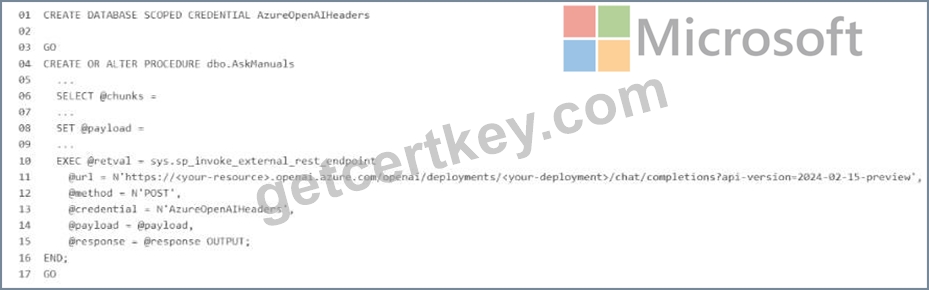
What should you insert at line 02?
- A.

- B.

- C.

- D.

- E.

Answer: B
Explanation:
The correct answer is Option B because the requirement is to call an Azure OpenAI REST endpoint from SQL Server 2025 while providing the highest level of security , and the instance already has a managed identity enabled . For Microsoft's SQL AI features, the preferred secure pattern is to use a database scoped credential with IDENTITY = ' Managed Identity ' instead of storing an API key. Microsoft documents that SQL Server 2025 supports managed identity for external AI endpoints, and for Azure OpenAI the credential secret uses the Cognitive Services resource identifier: { " resourceid " : " https://cognitiveservices.azure.
com " } .
So line 02 should be:
WITH IDENTITY = ' Managed Identity ' ,
SECRET = ' { " resourceid " : " https://cognitiveservices.azure.com " } ' ; Why the other options are incorrect:
* A and D use HTTP header or query-string credentials with an API key , which is less secure than managed identity because a secret key must be stored and rotated manually. Microsoft recommends managed identity where supported to avoid embedded secrets.
* C mixes Managed Identity with an api-key secret, which is not the correct pattern for Azure OpenAI managed-identity authentication.
* E uses an invalid identity value for this scenario. The accepted credential identities for external REST endpoint calls include HTTPEndpointHeaders , HTTPEndpointQueryString , Managed Identity , and Shared Access Signature .
Because the endpoint is Azure OpenAI and the question explicitly asks for the highest security , managed identity with the Cognitive Services resource ID is the Microsoft-aligned answer.
NEW QUESTION # 82
You have an Azure container app named app1-contoso-001 that hosts a Data API builder (DAB) container in front of an Azure SQL database.
You add an entity named Todo that uses a source named dbo.todos.
Which URL pattern should clients use to access the Todo REST endpoint?
- A. https://appl-contoso-001.azurestaticapps.net/api/Todo
- B. https://appl-contoso-001.azurestaticapps.net/data-api/graphq1/Todo
- C. https://appl-contoso-001.azurestaticapps.net/data-api/api/Todo
- D. https://appl-contoso-001.azurestaticapps.net/data-api/Todo
Answer: A
Explanation:
To access the REST endpoint for the Todo entity, clients should use the following URL pattern:
https://<your-container-app-url>/api/Todo
Base URL: The unique FQDN of your Azure Container App.
Path Prefix: By default, DAB uses /api for RESTful services.
Entity Name: You must use the Entity Name defined in the configuration (Todo), not the underlying source name (dbo.Todos).
Reference:
https://learn.microsoft.com/en-us/azure/container-apps/connect-apps
NEW QUESTION # 83
Case Study 2 - Fabrikam
Existing Environment
Azure Environment
Fabrikam has a single Azure subscription in the East US 2 Azure region. The subscription contains an Azure SQL database named DB1. DB1 contains the following tables:
* Patients
* Employees
* Procedures
* Transactions
* UsefulPrompts
* ProcedureDocuments
You store a column master key as a secret in Azure Key Vault.
You have an on-premises application named TransactionProcessing that uses a hard-coded username and password in a connection string to access DB1.
Problem Statements
Users report that after executing a long-running stored procedure named sp_UpdateProcedureForPatient, updates to the underlying data are sometimes inconsistent.
Requirements
Planned Changes
Fabrikam plans to manage all changes to Azure SQL Database objects by using source control in GitHub. Every pull request submitted to production will be validated before it can be merged.
Deployments must use the Release configuration.
Security Requirements
Fabrikam identifies the following security requirements:
* The TransactionProcessing application must use a passwordless connection to DB1.
* The Employees table contains two columns named TaxID and Salary that must be encrypted at rest.
* Auditors must have a tamper-evident history of transactions with cryptographic proof of changes to the employee data.
Database Performance Requirements
Records accessed by using sp_UpdateProcedureForPatient must NOT be changed by other transactions while the stored procedure runs.
AI Search, Embeddings, and Vector Indexing
Fabrikam identifies the following AI-related requirements:
* Queries to the ProcedureDocuments table must use Reciprocal Rank Fusion (RRF).
* Users must be able to query the data in DB1 by using prompts in Copilot in Microsoft Fabric.
* The UsefulPrompts table will store prompts that doctors can use to help diagnose patient illness by connecting to an Azure OpenAI endpoint.
Development Requirements
Fabrikam identifies the following development requirements:
* Provide the functionality to retrieve all the transactions of a given patient between two dates, showing a running total.
* Expose a Data API builder (DAB) configuration file to enable Azure services to perform the following operations over a REST API:
- Read data from the procedures table without authentication.
- Read and insert data into the Transactions table once authenticated.
- Execute the sp_UpdateProcedurePatient stored procedure.
* Provide the functionality to retrieve a list of the names of patients who underwent medical procedures during the last 30 days.
* Information for each medical procedure will be stored in a table. The table will be used with a large language model (LLM) for user querying and will have the following structure.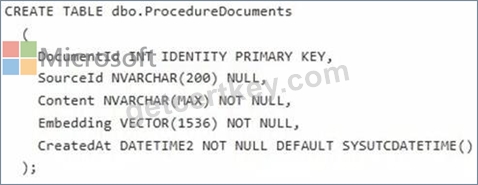
DAB
You create a DAB configuration file that meets the development requirements for DB1 and includes the following entities.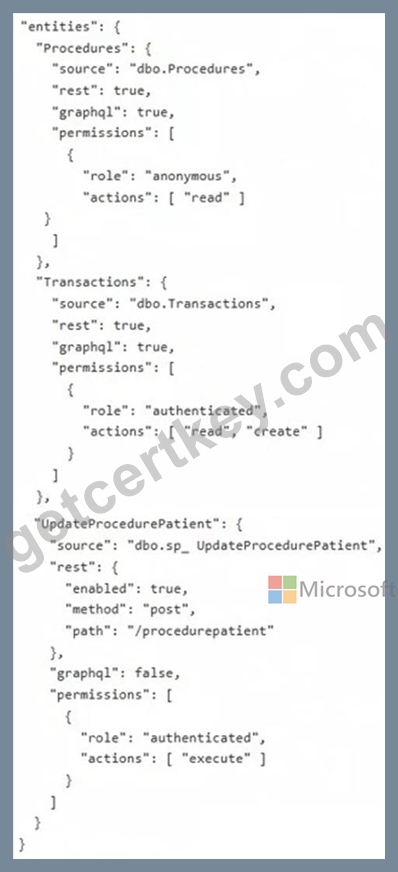
Hotspot Question
You need to create a solution that meets the development requirements for retrieving the patient lists.
How should you complete the Transact-SQL code? To answer, select the appropriate options in the answer area.
NOTE: Each correct selection is worth one point.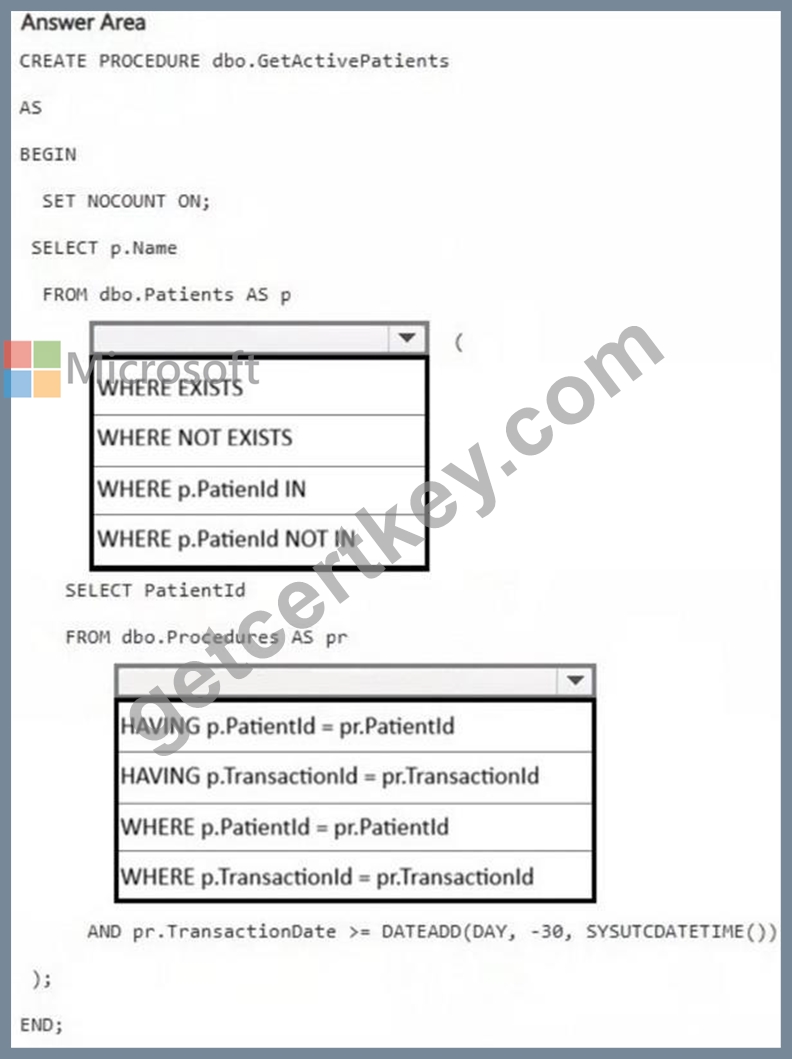
Answer:
Explanation: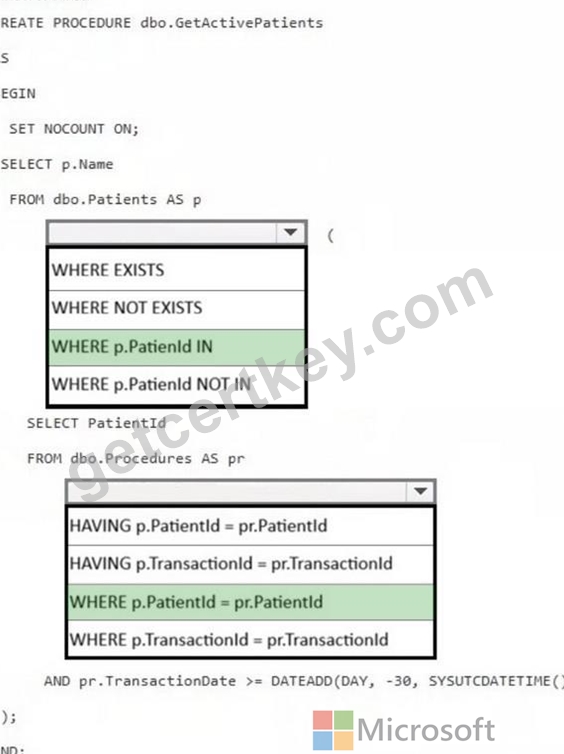
NEW QUESTION # 84
......
If you are a beginner, start with the DP-800 learning guide of practice materials and our DP-800exam questions will correct your learning problems with the help of the test engine. All contents of DP-800 training prep are made by elites in this area rather than being fudged by laymen. Let along the reasonable prices which attracted tens of thousands of exam candidates mesmerized by their efficiency by proficient helpers of our company. Any difficult posers will be solved by our DP-800 Quiz guide.
Valid Dumps DP-800 Free: https://www.getcertkey.com/DP-800_braindumps.html
- Microsoft New DP-800 Exam Question: Developing AI-Enabled Database Solutions - www.vce4dumps.com Help you Pass Once ➡ Download ➽ DP-800 ???? for free by simply searching on ✔ www.vce4dumps.com ️✔️ ????DP-800 New Questions
- DP-800 Valid Mock Exam ???? DP-800 Valid Exam Materials ???? DP-800 Reliable Exam Pass4sure ???? Easily obtain free download of ⏩ DP-800 ⏪ by searching on ⇛ www.pdfvce.com ⇚ ????DP-800 Exam Sample
- To Become a Certified Holder Prepare With Actual Microsoft DP-800 Questions ???? Easily obtain free download of 《 DP-800 》 by searching on ➡ www.prepawayete.com ️⬅️ ????DP-800 Valid Test Practice
- Valid Dumps DP-800 Ebook ???? DP-800 Reliable Exam Pass4sure ???? DP-800 Latest Test Experience ❇ Search for { DP-800 } and obtain a free download on “ www.pdfvce.com ” ????DP-800 New Questions
- Free PDF 2026 Microsoft DP-800 Marvelous New Exam Question ???? Copy URL ▶ www.prep4away.com ◀ open and search for ➡ DP-800 ️⬅️ to download for free ⛳DP-800 Trustworthy Practice
- To Become a Certified Holder Prepare With Actual Microsoft DP-800 Questions ???? The page for free download of ⮆ DP-800 ⮄ on { www.pdfvce.com } will open immediately ????DP-800 Latest Test Experience
- DP-800 Test King ???? DP-800 New Dumps Pdf ???? Latest DP-800 Demo ⛽ Search for 「 DP-800 」 and download it for free on [ www.prep4away.com ] website ????Exam DP-800 Objectives
- DP-800 Valid Exam Materials ???? Detailed DP-800 Study Dumps ???? DP-800 Pdf Demo Download ???? Simply search for 【 DP-800 】 for free download on ➥ www.pdfvce.com ???? ????Detailed DP-800 Study Dumps
- Quiz 2026 Microsoft DP-800: Fantastic New Developing AI-Enabled Database Solutions Exam Question ???? Go to website ⇛ www.practicevce.com ⇚ open and search for ➥ DP-800 ???? to download for free ????Vce DP-800 Format
- DP-800 New Questions ???? DP-800 New Questions ???? Valid Dumps DP-800 Ebook ???? Search on 「 www.pdfvce.com 」 for ✔ DP-800 ️✔️ to obtain exam materials for free download ⬆DP-800 Valid Mock Exam
- To Become a Certified Holder Prepare With Actual Microsoft DP-800 Questions ‼ Open “ www.vce4dumps.com ” enter ➡ DP-800 ️⬅️ and obtain a free download ????Vce DP-800 Format
- aishaakgu181273.blogozz.com, victorqdua097451.dreamyblogs.com, mylittlebookmark.com, dianebqhg420478.digitollblog.com, lingeriebookmark.com, saulqfnh493374.wannawiki.com, myportal.utt.edu.tt, myportal.utt.edu.tt, myportal.utt.edu.tt, myportal.utt.edu.tt, myportal.utt.edu.tt, myportal.utt.edu.tt, myportal.utt.edu.tt, myportal.utt.edu.tt, myportal.utt.edu.tt, myportal.utt.edu.tt, cormacrtom679722.theideasblog.com, myportal.utt.edu.tt, myportal.utt.edu.tt, myportal.utt.edu.tt, myportal.utt.edu.tt, myportal.utt.edu.tt, myportal.utt.edu.tt, myportal.utt.edu.tt, myportal.utt.edu.tt, myportal.utt.edu.tt, myportal.utt.edu.tt, aoifexqjm120689.blogspothub.com, Disposable vapes